


October is Breast Cancer Awareness month. Breast cancer is one of the world’s most prevalent types of cancer. In fact, it is growing so much every year, even among younger women that it is being called an epidemic. There is The Breast Cancer Risk Assessment Tool also known as the Gail Model that collects health history and is very accurate. What factors increase the risk of breast cancer?
If you are in a high-risk category, have hope in making strategic choices for prevention! Nutrigenomics is the study of how nutrition does help our health and impacts disease. More and more is known on the importance of the microbiome in our gut, where our immune system operates from. Cancer can be considered a sign of an immune deficiency, for our immune system continuously takes out DNA damaged rouge cancerous cells, but if it has been weakened by poor diet/stress, tumors can have a chance to form. Science knows we need 9-13 cups of fruits and vegetables of all colors every day for optimal fuel. (Good self-care and nutritionally supporting the body tips at end).
The next best thing is early detection. Doctors are told to recommend to women annual mammograms starting in the mid-40’s, but there are concerns with that. Dr Joseph Mercola states, “Mammograms expose your body to radiation that can be 1,000 times greater than that from a chest x-ray, which itself poses risks of cancer.” Dr. Samuel Epstein, one of the world’s top cancer experts, stated: “The premenopausal breast is highly sensitive to radiation, each 1 rad exposure increases breast cancer risk by about 1 percent, with a cumulative 10 percent increased risk for each breast over a decade’s screening. Up to 20% of all breast cancers diagnosed in the United States annually are actually linked to the cumulative radiation effects of mammograms”
Since traditional mammography compresses your breasts tightly, and often painfully, Dr. Charles B. Simone, a former clinical associate in immunology and pharmacology at the National Cancer Institute, said, “Mammograms increase the risk for developing breast cancer and raise the risk of spreading or metastasizing an existing growth.” And there is another serious problem:
Mammograms Often Give False Positives
Aside from the radiation risks, mammograms carry a first-time false positive rate of up to 6 percent. False positives can lead to expensive repeat radiation exposure screenings and can sometimes result in unnecessary invasive procedures including biopsies and surgeries. A false positive on a mammogram can bring on fear, agreeing to an unnecessary biopsy, and both can be damaging. Women have unnecessarily undergone mastectomies, radiation and chemotherapy after receiving false positives on a mammogram when they did not have cancer. In July 1995, The Lancet (a peer reviewed medical journal) again wrote about mammograms, saying “The benefit is marginal, the harm caused is substantial, and the costs incurred are enormous …”
What are healthier alternatives?
Thermography
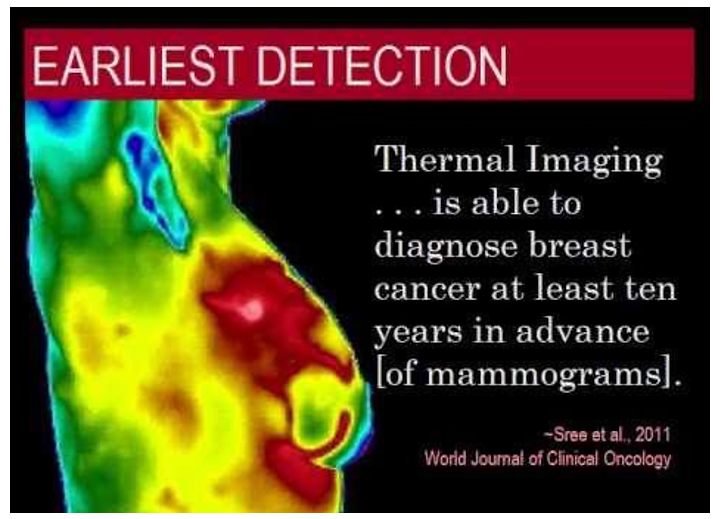
This non-invasive technology screens for the vascular changes associated with early breast cancer. An infrared camera takes pictures to show skin temperature differences, and areas getting a higher blood supply indicate a possible tumor. There are no side effects, but reportedly are not as sensitive as a mammogram, but a study found it had 97% sensitivity (2008 New York Presbyterian-Cornell). It identified 58 out of 60 malignancies years before a lump appeared. If there is an area of suspicion, an ultrasound test can be done to investigate further. An ultrasound also poses no health risk, is a more effective tool for dense breasts than a mammogram, and can view all the way to the chest wall for abnormalities. One woman who got a mammogram that indicated a suspected tumor, rather than get a biopsy to verify, got an ultrasound which found that it was just a blocked milk duct.
The Oncoblot Test
It is a blood test that measures the presence of the Enox2 protein which only cancer cells produce. It can detect cancer so early it can find a growth that is the size of a pinhead! (based on over 20 years of research and can detect over 25 types of cancers)
The Greece Test
The Greece Test measures the number of circulating tumor cells (CTC) in the blood. This as well as the Oncoblot Test can detect cancer so early that natural health protocols can be utilized first, ranging from high dose Vitamin C+ IVs, Ivermectin (which a recent major study found has proven to be more effective than chemotherapy), and mistletoe to name a few.
The Cancer Profile Test
The Cancer Profile Test uses sensitive technology which can detect broadspectrum cancer tumor markers, including hormones. One identifier is HCG which is elevated 80% of the time when there is a malignancy. Another marker they look for is an enzyme PHI.
Breast Awareness and Self-Exams
Standing in front of a mirror, look and feel for changes such as dimpling, swelling, lumps, discharge. Being familiar with your body’s condition will help you be aware of changes.
Eighty percent of chronic diseases, including cancer, can be avoided with good nutrition and lifestyle. Focus on sulforaphane-rich foods such as broccoli sprouts, and herbs like curcumin in the daily diet. The average person needs 9-13 cups of fruits and vegetables as well as Omegas, sleep, exercise, sun, staying hydrated…avoiding fried, sugary, chemically laden or man-made food. Epigenetics has found providing the needed nutrition our body needs every day will help turn on the good genes, and keep the bad genes turned off. And this strategic blend of vine-ripened 30 fruits & vegetables in capsules or chewables has been found to positively change over 1600 genes in out DNA! Now that is good news to know about!
Beloved, I pray that all may go well with you and that you may be in good health, just as it is well with your soul. 3 John 1:2
Disclosure: This contains an affiliate link. If you purchase through my link, I receive a small commission, but it will not affect your purchase price. I only recommend what I have researched, love and what I use and recommend to all my friends.
All information posted whether in text, graphics, images or other material is merely for educational and informational purposes, I am not a doctor. It is not intended as a substitute for professional advice, diagnosis, or treatment. Seek advice from your physician or qualified health care provider. Should you decide to act upon any information on this website, you do so at your own risk. While the information on this website has been verified to the best of our abilities, we cannot guarantee that there are no mistakes or errors. It was based on current information at the time of writing.









 SINCE 1979